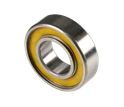
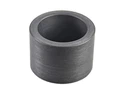
Bearings are critical mechanical components primarily designed to support loads and reduce the coefficient of friction during mechanical transmission.
The term "bearings" typically refers to ball bearings and roller bearings. A rolling bearing is a precision mechanical component that transforms sliding friction between a rotating shaft and its housing into rolling friction, thereby minimizing energy losses due to friction. Rolling bearings that support radial loads are generally composed of four main components: an inner ring, an outer ring, rolling elements, and a cage that separates and guides the rolling elements.
Bearings can be categorized based on their applications into motor bearings, automotive bearings, machine tool bearings, roller bearings, agricultural machinery bearings, robot bearings, and others.
1. Motor Bearings: Electric motors are extensively used across various types of mechanical equipment. To a significant extent, the operational performance of a motor is influenced by the smoothness and reliability of its bearings. These bearings are typically required to operate with low noise, high cost-efficiency, and a simple supporting structure. Deep groove ball bearings are commonly selected for such applications.
2. Automotive Bearings: These include wheel hub bearing units, clutch release bearings, universal joint cross bearings, water pump bearings, and tensioner wheel bearing units. Additional specialized bearings used in the automotive industry include railway bearings, aero-engine bearings, instrumentation bearings, agricultural machinery bearings, and robot bearings.
3. Machine Tool Bearings: Bearings are essential components in machine tools, where their performance directly affects the machining quality of workpieces and overall production efficiency. Commonly used types include deep groove ball bearings, angular contact ball bearings, tapered bore double-row cylindrical roller bearings, tapered roller bearings, thrust ball bearings, thrust roller bearings, and double-direction thrust angular contact ball bearings.
4. Rolling Mill Bearings: Rolling mills can be classified as two-high, four-high, six-high, or even twenty-high mills. Roll bearings are installed at the journal ends of both the working rolls and support rolls. These bearings must withstand substantial radial rolling forces while operating within limited radial installation space. Therefore, multi-row roller bearings are typically employed for all roll applications.
Aug 21, 2025
What Are The Classifications Of Bearings Based On Their Applications?
Send Inquiry
Product Categories
Latest Products