


Material
Wholesale Bearing Material Supplier
Professional Manufacturing
Lianyi Bearing is a manufacturer and exporter of a full range of tapered roller bearings, deep groove ball bearings and housed ball bearings. There are more than 300 employees, including engineering and technical personnel, and the factory building area is 30,000 square meters.
R&D and Patents
Currently, there are 40 R&D engineers in the R&D department, including more than 20 with master's degree or above. We own more than 30 patents and software copyrights, and have developed one of the most comprehensive sliding bearing R&D systems in the world.
Quality Control
We use advanced automated production lines and testing lines for tapered rollers, deep groove ball bearings, and seated ball bearings. We strictly adhere to the ISO 9001 quality management system to provide you with high-quality and reliable products.
Solution Provider
We provide solutions based on your requirements, specified materials and product structures are available, and will provide a complete DFMEA for the product as soon as possible for subsequent production. And our proprietary materials are competitively priced.


Product Categories
Latest Products


Products Description
|
Specifications |
Available Options |
|
Bearing Types |
Permanent Self-Lubricated Greaseless Oil Less Maintenance Free Self-aligning |
|
Applications |
Medium-to-Heavy Loads Slow-to-Medium Speeds |
|
Environment |
Wet Dry High Temperature Low Temperature Hostile Irradiated or Radiation Environment |
|
Configurations |
One-Piece Bushings Split Bushings Two-Piece Bushings Flanged Bushings Self-Aligning Spherical Bushing Thrust and Expansion Washers Liners Flat Plates Radialube® Spherilube® Plates Special Shapes |
|
Peripheral Parts |
Support Systems Structural Components Mating Pins Shafts Housings |
|
Manufacturing Process |
CNC Machining Welding Painting |
|
Lubricant Form |
Dry Solid Permanent Self-Lubricating |
Common Materials Used in Bearings


1.Metallic Materials
a.Chrome Steel SAE 52100
Roller, ball and tapered roller bearings are usually made of chrome SAE 52100 bearing steel. This material has excellent wear resistant capacity and a Rockwell hardness of about 64 HRC. Bearings made of chrome steel can function at temperatures up to 120°C, and upon heat treatment, they can even go as high as 220°C. However, one disadvantage of chrome steel bearings is the low chromium content that makes them prone to corrosion.
b.Stainless Steel AISI 440C
Stainless steel bearings have a higher chromium content (up to 18%) that makes them superior to SAE 52100 in terms of corrosion resistance. They can function at temperatures as high as 250°C but are low in hardness and overall load-carrying capacity, in addition to having a higher production cost. AISI 440C is a high-carbon stainless steel used in rolling-contact bearings (ball or roller bearings).
c.Martensitic Stainless Steel SV30
Martensitic stainless steel can be modified during the processing of the raw steel by lowering the carbon content and introducing nitrogen as an alloying element. The nitrogen increases the saturation of the chromium, which transforms into chromium nitrides instead of chromium carbides. The result is a high strength, high hardness steel with a superior microstructure that extends fatigue life by as much as 100% (double) in certain applications.
2.Non-metallic Materials
a.Nylon
Nylon is a polyamide, a crystalline material widely used in bearing materials as a sintered layer inside a metal sleeve or an injection-moulded sleeve. It has excellent toughness, wear characteristics, and fatigue and chemical resistance. Nylon filled with MoS2 in particular is enhanced with lubricating properties and are well-suited for bearings.
b.Phenolic Materials
Phenolic materials are usually used for cages of high-speed ball bearings such as in machine tool equipment spindles. They are good resistors to water, acidic, and alkali solutions. However, they have a low thermal conductivity and they tend to expand, which render them less desirable in high load-speed applications.
c.Nitrile Rubber
Buna or nitrile rubber is one of the most common bearing seal materials. It is resistant to many chemicals and can be used in a wide temperature range. It also has good mechanical properties and is cheap to produce. Bearing seals can also be made of silicone and viton.
d.Teflon
Polytetrafluoroethylene (PTFE), commonly known as Teflon, is a thermoplastic polymer material whose high chemical inertness, self-lubricating property, and low friction coefficient makes it a suitable material for rolling-element bearing cages, journal, and sliding bearings, among others.
Lianyi Bearing independently developed self-lubricating and water-lubricated bearing materials, eliminating the need to frequently add lubricating oil to the bearings. This saves lubricating oil consumption, reduces machine downtime and maintenance costs, and is environmentally friendly. Let me recommend some high-quality bearing manufacturing materials to you!

What is Peek Based Material
PEEK (polyetheretherketone) is semicrystalline thermoplastic known for retaining its functionality at high temperatures and in challenging environments. This includes aspects such as strength, wear resistance, dimensional and structural stability, and chemical inertness. These factors alone have convinced many engineers to switch from traditional bearing materials to PEEK.
Characteristics of Peek As a Bearing Material

01
Efficiency
PEEK is lightweight and strong, giving it a high strength-to-weight ratio. This means that a metal bearing would weigh significantly more than its equivalent PEEK counterpart. This not only reduces overall weight, but also the inertia of the system, which in turn can increase efficiency.

02
Reinforcement
By reinforcing PEEK with carbon fibers, its load bearing capacity and dimensional stability are increased. The carbon fibers will increase PEEKs ability to dissipate heat, reducing the chances of thermal expansion. Such characteristics are vital for bearings in high performance applications, where a slight change in bearing geometry could result in a system failure.

03
Lubrication
Plain PEEK has a low coefficient of friction. By adding graphite and PTFE filler, friction can be further reduced. The ability to add such fillers to PEEK can result in self-lubricating bearings with increased wear resistance.

04
Manufacture
PEEK is compatible with various manufacturing processes, with bearings typically produced using machining and injection molding. Both modern CNC machining and injection molding support the efficient manufacture of high precision, complex parts such as bearings.
PEEK Bearing Advantages
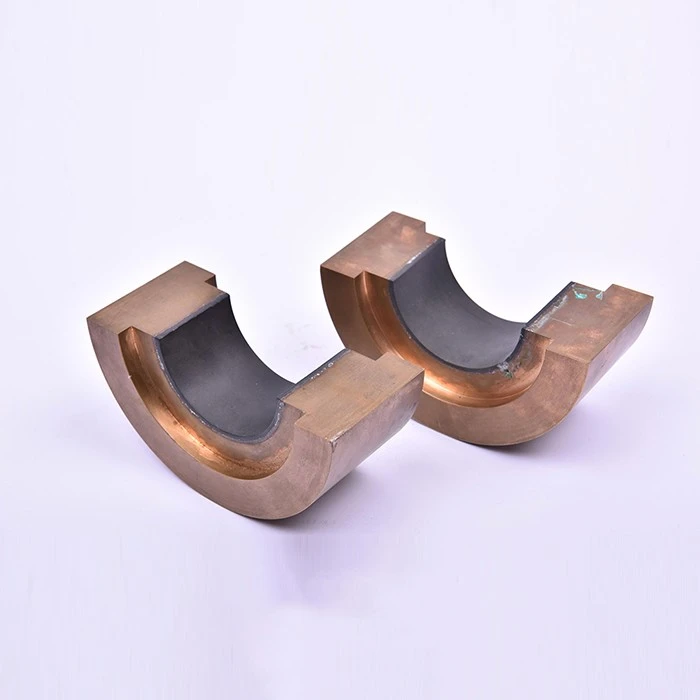
The application of engineered polymer on tilt pad thrust and journal bearings provides a number of application benefits.
Operation with thinner hydrodynamic films for:
- High load capacity - up to 10 MPa (1500 psi)
- Reduced power loss - up to 30% savings
- Operation with low-viscosity lubricants
- Higher temperature capabilities - up to 250°C (482°F)
- Operation with challenging lubricants and process fluids
- Higher start-up load capability without hydrostatic lift
- Corrosion resistance
- Electrical insulation to prevent damaging currents from passing through the bearing and housing to ground
- Embedability similar to that of babbitt
Popular Application of Polyetheretherketone (PEEK)
Automotive
With the growing trend of miniatured engine compartments, PEEK offers a solution to replace metals and offer weight reduction, noise reduction and functional integration. The most important performance benefits of Polyetheretherketone are enhanced dry and lubricated surface interaction, outstanding mechanical performance over a wide temperature range, ease of processing and excellent fatigue properties.
Aerospace
PEEK polymers and its composites are replacing aluminum and other metals in several aircraft parts. Huge numbers of large volume components with fine tolerances can be cost-effectively formed and used without assembly or modification.
Medical and Healthcare
Polyetheretherketone provides cost-effective, innovative parts with excellent wear, heat, electrical and chemical resistance. Its applications in healthcare mainly consist of dental instruments, endoscopes and dialyzers.
Electrical/Electronic
Polyetheretherketone possesses excellent electrical properties, which makes it an ideal electrical insulator. Some interesting examples of current applications include coaxial connector jacks used in hands-free telephone kits, surface-mounted trimming potentiometers, which are electro-mechanical devices, known as SMDs, designed to correct voltage or resistance errors in printed circuit boards, and as insulators for connector pins on under-sea environment control equipment.

Filament Winding Material for Bearings
To meet the need for high load, self-lubricating bearings that provide low wear rates, we developed our line of Fiber Reinforced Composite bearings. Combining the excellent lubricating properties of filled PTFE (polytetrafluoroethylene) with the high strength and stability of epoxy-impregnated, wound glass fibers, this tough, high strength line of bearings provide the radial and axial strength required to support high bearing loads.
Benefits of a Filament Wound Bearing
Element Of Elasticity
Filament wound bearings present a good level of elasticity that falls between rigid metals and soft plastics. This modulus gives the bearing surface the ability to support heavy loads, but enough flexibility to tolerate shaft misalignment without stressing the bearings ends.
Shock Absorption
A composite filament wall acts like a spring to absorb shock and vibration in high-stress environments. Even our thin wall CJ’s have the ability to compress and recover during shock and impact conditions without failure.
Resistance to Corrosion
The special winding technique and multilayer construction gives filament bearings good resistance to chemical, galvanic (electrochemical contact) and fretting corrosion. These are all primary causes of bearing failure. Explore more causes of bearing failure.
Versatile Motions
Filament wound CJ’s and FCJ’s are best applied in oscillating motions at variable frequencies but can also be utilized in lubrication free rotary and lineal motions.
Good Service Lifetime
A filament wound composite is best used against a hard shaft and 8-16 rms finish to resist abrasion and fretting and improve overall service. In fact, one test showed that improving the surface of 50-55 Rc hardness and an 8 rms finish could extend the wear life of a bearing from 500,000 cycles to over 1 million cycles. All without lubrication.
Self-Lubricating Qualities
Composite bearings run dry and grease-free to help you save on all costs associated with manual grease application.
Applications of Filament Winding Material
Laboratory and field testing have proven that Fiber Reinforced Composite bearings provide outstanding performance in a wide variety of demanding dry or lubricated bearing applications such as:
- Aerial lifts GGB
- Aerospace and space applications
- Agricultural equipment
- Construction equipment
- Material handling equipment
- Processing equipment
- Railroad applications
- Snowmobile and ATV CVT clutches GGB
- Waste and recycling equipment
- Water turbines
- Wind turbines


Filament Winding Process
Continuous fiber tows are fed through a fiber delivery system to the filament winding machine, where they are wound onto a mandrel in a predetermined, repeating geometric pattern. The tow location is guided by a fiber delivery head, which is attached to a movable carriage on the filament winding machine. The relative angle of the tow to the mandrel axis, called the winding angle, can be tailored to provide strength and stiffness in the desired directions. When sufficient layers of tow have been applied, the resulting laminate is cured on the mandrel. The overall size and shape of the finished part are determined by the mandrel shape and thickness of the laminate.
The winding angles will determine the mechanical properties of the composite part, such as strength, stiffness, and weight. The density of the laminate is the result of the tension of the tows during winding. The composite parts made through these methods generally have good strength-to-weight properties.
Innovation Patents
LIANYI Bearing owns more than 30 patents and software copyrights. Our independently developed self-lubricating and water-lubricating materials are unique and have the advantages of oil-free, maintenance-free and low-cost.

Frequently Asked Questions
s one of the leading material manufacturers and suppliers in China, we warmly welcome you to buy material made in China here from our factory. All customized products are with high quality and competitive price. Contact us for more details.
